
RESEARCH
POSTERS

SJSU College of Science's 21st
Student Research Day 2026
Suppressor Mutations in a Dual Sensor Regulator Allow Metabolic Rewiring for Lanthanide Acquisition in Methylobacterium extorquens AM1
This study investigates the role of a suppressor mutation in a dual sensor regulator and its potential contribution to metabolic rewiring for lanthanide acquisition in Methylobacterium extorquens AM1. Through genetic and physiological analyses, this work examines how regulatory adaptation may compensate for defects in metal uptake and restore lanthanide-dependent growth. These findings contribute to a broader understanding of the regulatory networks that support methylotrophic metabolism under conditions of disrupted transport.
Additional details available upon request.

23rd Microbiology Student Symposium 2024
Development and Implementation of CRISPR/Cas9 Gene Editing for Methylotrophic Bacteria
This project describes the development and implementation of a CRISPR/Cas9-based gene editing strategy for methylotrophic bacteria. The work focuses on establishing a molecular toolkit for targeted genome modification to facilitate the functional analysis of genes involved in metabolism, regulation, and environmental adaptation. The establishment of these methods provides a foundation for more precise genetic interrogation of methylotrophic systems.
Additional details available upon request.
2nd Annual Basic Science Symposium 2024
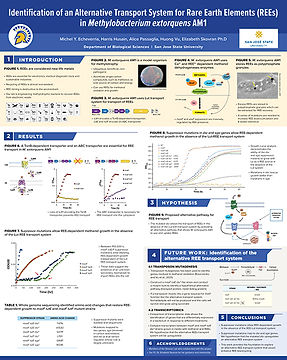
Identification of an Alternative Transport System for Rare Earth Elements (REEs) in Methylobacterium extorquens AM1
This research examines the possibility of an alternative transport system for rare earth elements in Methylobacterium extorquens AM1 in the absence of the primary uptake pathway. Using mutant-based approaches and growth analyses, the study evaluates mechanisms that may permit continued lanthanide-dependent metabolism despite disruption of canonical transport functions. This work advances understanding of metal acquisition pathways and their importance in the physiology of methylotrophic bacteria.
Additional details available upon request.